The Hard Thing About Hard Things: What Nobody Tells You About Building a Business
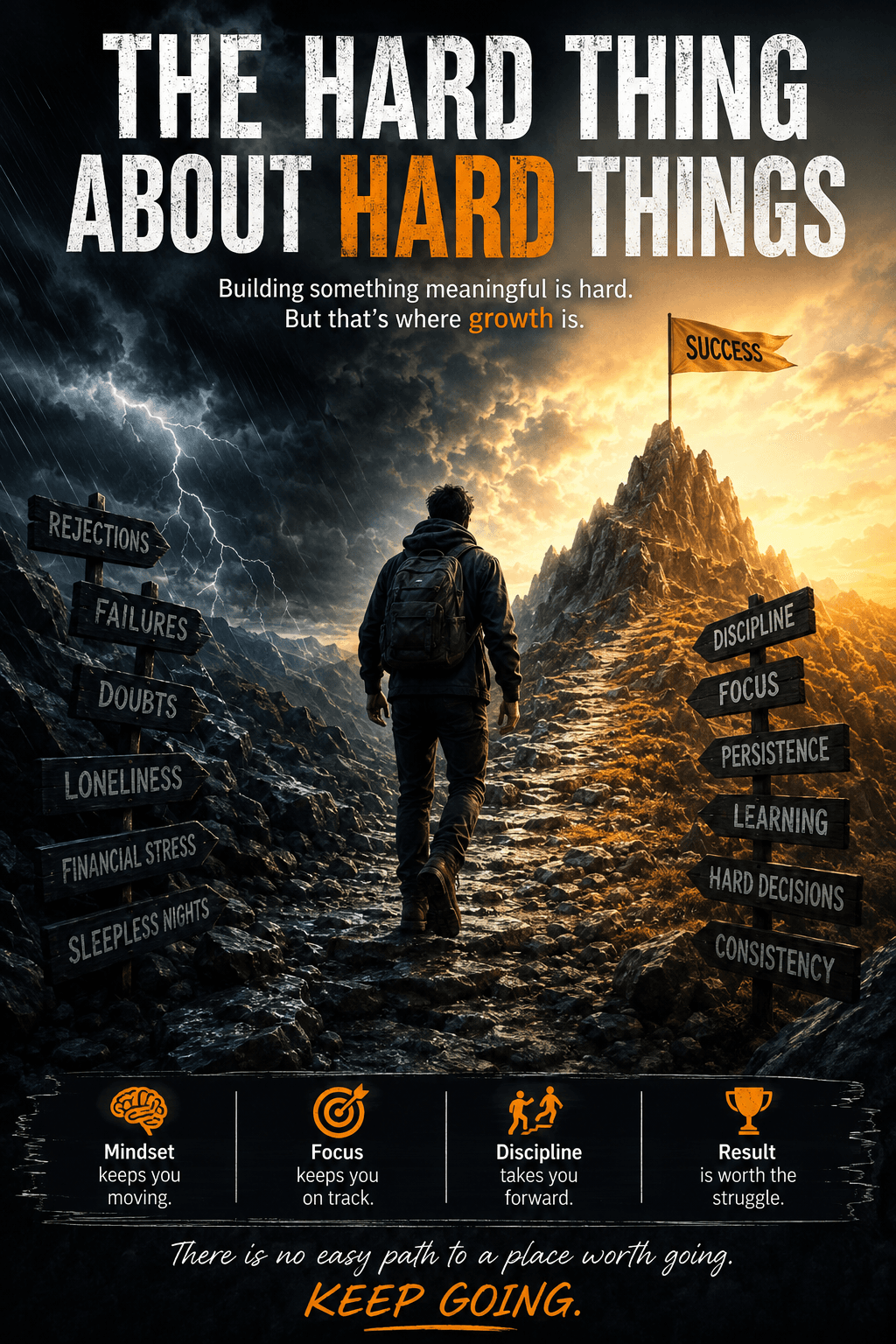
A practical lesson in resilience, leadership, uncertainty, and doing the work when there is no easy answer
There is a version of entrepreneurship that looks beautiful from the outside.
You have an idea.
You build a product.
Customers arrive.
Revenue grows.
You hire a team.
You become successful.
But real entrepreneurship rarely looks like that.
link
The reality is much messier.
There are days when nobody responds to your emails. There are months when revenue doesn't grow. Employees leave. Customers complain. Products fail. Competitors move faster. You make decisions without having enough information. And sometimes, you wake up wondering whether you made a terrible mistake by starting in the first place.
That is the hard thing about hard things.
The difficult problems usually don't come with instructions.
And that is exactly what makes entrepreneurship so powerful.
- There Is No Perfect Roadmap
One of the biggest misconceptions about business is that successful people always know what they are doing.
They don't.
They simply become better at making decisions when the answers aren't obvious.
When you're building something new, there is rarely a perfect playbook.
You may ask:
Should I hire or outsource?
Should I raise prices?
Should I change the product?
Should I continue or quit?
Should I focus on customers or investors?
Should I expand or stay small?
There isn't always a correct answer.
Sometimes you have to make the best decision you can with the information available and accept that you may be wrong.
Leadership isn't about always being right. It's about being willing to make difficult decisions and take responsibility for them.
- Motivation Will Not Always Be There
Motivation is useful.
But motivation is unreliable.
Some mornings you'll feel unstoppable.
Other mornings, you'll have absolutely no desire to work.
If your progress depends entirely on motivation, your progress will stop whenever motivation disappears.
Successful people learn to work even when they don't feel like working.
They build systems.
They create routines.
They show up.
They keep moving.
The difference between a dream and a business is often thousands of boring actions repeated consistently.
You don't need to feel motivated every day. You need to remain committed to the mission.
- Problems Don't Disappear When You Become Successful
Many people think success means reaching a point where problems disappear.
The opposite is usually true.
Small businesses have small problems.
Growing businesses have bigger problems.
Large companies have complicated problems.
When you grow, your problems change.
At the beginning, your problem might be:
"How do I get my first customer?"
Later it becomes:
"How do I serve 1,000 customers without destroying the quality?"
Then:
"How do I build a team capable of operating without me?"
Growth doesn't eliminate problems.
Growth gives you better problems to solve.
- You Will Make Mistakes
You will hire the wrong person.
You will build something nobody wants.
You will spend money on the wrong marketing strategy.
You will trust the wrong partner.
You will make a decision that looks terrible six months later.
This is normal.
The goal isn't to avoid every mistake.
The goal is to learn faster than your mistakes can hurt you.
A mistake becomes valuable when it produces a lesson.
Ask yourself:
What happened?
Why did it happen?
What did I miss?
What will I do differently next time?
Don't turn mistakes into shame.
Turn them into systems.
- Sometimes You Have to Be the Bad Guy
Leadership isn't always about making people happy.
Sometimes leadership means saying:
No.
No to unnecessary expenses.
No to poor performance.
No to unrealistic promises.
No to toxic behavior.
No to customers who aren't a good fit.
No to opportunities that distract from the mission.
A leader who tries to make everyone happy eventually makes nobody happy.
Good leaders care about people.
Great leaders also care about the health of the organization.
Kindness and accountability can exist together.
You can respect someone and still hold them to a high standard.
- The Company Will Test Your Character
When everything is going well, leadership is easy.
The real test comes when things go wrong.
A major customer leaves.
Revenue falls.
A project fails.
Your best employee resigns.
A competitor launches a better product.
Investors say no.
People start questioning your decisions.
Those moments reveal what kind of leader you really are.
You can panic.
You can blame everyone.
You can hide.
Or you can look at the situation honestly and ask:
"What can I do next?"
That question is incredibly powerful.
It moves your attention away from the problem and toward action.
- Building a Business Can Be Lonely
Entrepreneurship can be surprisingly lonely.
You may have employees, friends, family, and customers around you—and still feel like nobody completely understands the pressure you're carrying.
Everyone sees the results.
Very few people see the uncertainty behind them.
That's why founders need people they can trust.
Mentors.
Co-founders.
Friends.
Advisors.
Other entrepreneurs.
You don't have to carry every problem alone.
Asking for help isn't weakness.
Knowing when you need help is a form of strength.
- Cash Flow Can Matter More Than Your Big Idea
A brilliant idea doesn't automatically create a successful company.
A business needs customers.
Customers create revenue.
Revenue supports operations.
And cash keeps the company alive.
You can have an amazing product and still fail if you run out of money.
That's why entrepreneurs need to understand the boring numbers:
Revenue
Expenses
Gross margin
Cash flow
Customer acquisition cost
Customer lifetime value
Runway
Profitability
Innovation gets attention.
Cash flow keeps the lights on.
- Don't Confuse Activity With Progress
Being busy feels productive.
But busy doesn't necessarily mean effective.
You can spend eight hours answering emails and accomplish almost nothing important.
You can attend meetings all day and make zero meaningful progress.
You can constantly redesign your website instead of talking to customers.
The important question isn't:
"How busy was I today?"
Ask:
"What moved the business forward today?"
Maybe it was getting a customer.
Maybe it was fixing a critical product problem.
Maybe it was hiring an excellent employee.
Maybe it was making one difficult decision.
Focus on outcomes, not activity.
- Customers Don't Care About Your Effort
This is a painful but important lesson.
You may have worked for six months on your product.
You may have sacrificed weekends.
You may have spent thousands of dollars.
You may genuinely believe your product is incredible.
But customers don't buy your effort.
They buy value.
They care about whether you solve their problem.
That means entrepreneurs must be willing to hear uncomfortable feedback.
Don't ask:
"Do you like my product?"
Ask:
"What problem does this solve for you?"
The second question gives you information.
And information is one of the most valuable assets in business.
- Keep Going—But Know Why
"Never give up" sounds inspiring.
But blindly continuing isn't always smart.
Sometimes persistence is exactly what you need.
Sometimes changing direction is the smarter move.
The key is knowing the difference between:
Giving up because things are difficult
and
Changing strategy because the evidence says your current strategy isn't working.
Don't be emotionally attached to a particular method.
Be committed to the mission.
Your strategy can change.
Your product can change.
Your business model can change.
Your timeline can change.
But your willingness to learn should remain.
- The Hardest Part Is Often Yourself
Business problems are not always external.
Sometimes the biggest obstacle is inside your own head.
Fear.
Ego.
Impatience.
Overconfidence.
Comparison.
Perfectionism.
Procrastination.
You may spend too much time comparing your chapter one to somebody else's chapter twenty.
You may avoid launching because the product isn't perfect.
You may refuse feedback because you believe you already know the answer.
You may chase every new opportunity because you're afraid of missing out.
Entrepreneurship forces you to confront yourself.
And that may be one of its greatest benefits.
Building a company often means building yourself at the same time.
The Real Meaning of Resilience
Resilience doesn't mean you never feel afraid.
It means you continue despite the fear.
It doesn't mean you never fail.
It means you learn from failure.
It doesn't mean you always know what to do.
It means you're willing to search for the answer.
It doesn't mean everything works.
It means you keep adapting.
The strongest entrepreneurs aren't necessarily the smartest people in the room.
Often, they are the people who can tolerate uncertainty longer, learn faster, and continue moving forward when things become uncomfortable.
Final Thought: Embrace the Hard Things
The easy things don't build extraordinary companies.
The difficult conversations do.
The failed experiments do.
The rejected proposals do.
The late nights do.
The uncomfortable decisions do.
The customer complaints do.
The mistakes do.
The moments when you want to quit—but decide to take one more step—do.
Building something meaningful is hard.
But perhaps that's the point.
If it were easy, everyone would do it.
The hard things develop the skills that success requires.
So when the next difficult problem appears, don't immediately ask:
"Why is this happening to me?"
Ask:
"What is this problem trying to teach me?"
Because the hard thing about hard things is that there is rarely an easy answer.
But somewhere inside the struggle is the experience that prepares you for the next level.
Keep building. Keep learning. Keep adapting.
And when the path becomes difficult, remember:
You don't need to know the entire path.
You only need to take the next step.
0 Comments
Log in to leave a comment.