🚀 How to Build a Marketing Strategy for a New Startup: A Complete Step-by-Step Guide
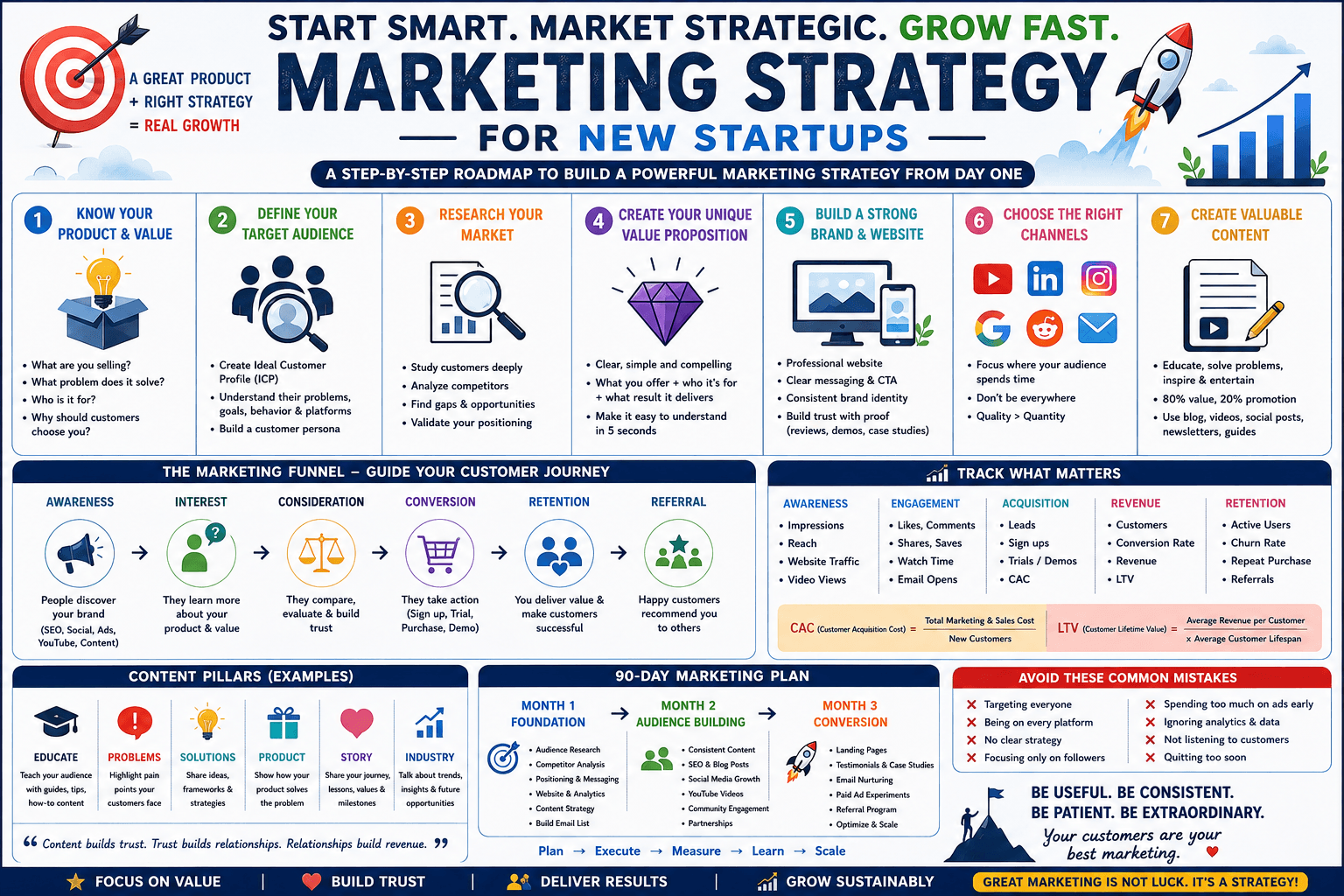
Starting a business is exciting.
You have a product, a vision, a name, and perhaps even a great website. But there is one difficult question every startup eventually faces:
“How do we get people to discover, trust, and buy our product?”
That is where marketing comes in.
A strong marketing strategy is not simply about posting on Instagram every day or running advertisements. It is a system for understanding your customers, positioning your product, building awareness, generating leads, converting customers, and creating long-term [growth.
link
For a new startup with a limited budget, marketing must be focused, measurable, creative, and consistent.
This guide explains how to build a marketing strategy from zero.
- Start With the Product, Not the Advertisement
One of the biggest mistakes startups make is starting marketing before clearly defining what they are selling.
Before creating social media posts, advertisements, videos, or email campaigns, answer five questions:
- What are you selling?
Clearly describe your product or service.
- Who needs it?
Identify your ideal customer.
- What problem does it solve?
Customers don't usually buy products simply because they exist.
They buy solutions.
- Why should customers choose you?
What makes your startup different?
- Why should they trust you?
You need evidence:
Reviews
Testimonials
Demonstrations
Case studies
Results
Expertise
Partnerships
Transparent information
A simple formula is:
Product + Problem + Customer + Differentiator = Foundation of Your Marketing
- Define Your Target Audience
You cannot market effectively to "everyone."
If your target audience is everyone, your marketing message usually becomes too generic.
Instead, create an Ideal Customer Profile (ICP).
For example, imagine you are launching an AI productivity application.
Your audience could be:
Primary audience:
Students and young professionals aged 18–30.
Problems:
Too much information
Difficulty organizing notes
Limited productivity
Difficulty researching topics
Goals:
Save time
Study better
Organize information
Become more productive
Now your marketing becomes much more specific.
Instead of saying:
"Our app is useful for everyone."
You could say:
"Turn your scattered notes into organized knowledge in minutes."
That is a much stronger message.
- Create a Customer Persona
Go one step further.
Create a fictional representation of your ideal customer.
Example
Name: Rahul
Age: 24
Occupation: Software developer
Location: Hyderabad
Income: ₹6–10 LPA
Interests: AI, technology, productivity
Problems: Lack of time, information overload
Platforms: LinkedIn, YouTube, Instagram, Reddit
Buying behavior: Researches products before purchasing
Now you can ask:
Would Rahul understand this advertisement?
Would Rahul click this headline?
Would Rahul share this content?
This makes your marketing much more customer-focused.
- Research Your Market
Before investing money, understand your market.
Research:
Customers
What problems do they have?
What products do they currently use?
What do they complain about?
What are they searching for?
What influences their buying decisions?
Competitors
Study:
Their website
Pricing
Features
Content
Social media
Reviews
Advertising
Customer complaints
Don't simply copy competitors.
Instead, find their weaknesses.
For example:
Competitor weakness Your opportunity
Complicated interface Build a simpler product
Expensive pricing Offer affordable plans
Poor customer support Provide better support
Limited features Solve a specific use case
Weak content Build an educational content engine
Your competitor's weakness can become your competitive advantage.
- Define Your Unique Value Proposition
Your Unique Value Proposition (UVP) explains why someone should choose your startup.
A good UVP answers:
What do you offer + who is it for + what result does it provide?
For example:
"An AI-powered workspace that helps students organize research, create notes, and learn faster."
Keep your UVP simple.
A visitor should understand your product within a few seconds of landing on your website.
- Build a Strong Brand
Marketing becomes much easier when people remember your brand.
Your brand includes:
Name
Logo
Colors
Typography
Voice
Story
Values
Visual identity
Customer experience
But branding isn't just a logo.
Your brand is:
What people think and feel when they hear your company's name.
For a technology startup, you might want your brand to feel:
Modern + Intelligent + Simple + Trustworthy
Make sure your website, social media, emails and advertisements communicate the same identity.
- Build a Professional Website
Your website is often your startup's most important marketing asset.
Your homepage should quickly answer:
What is this?
Who is it for?
What problem does it solve?
Why should I trust you?
What should I do next?
A simple homepage structure:
Hero Section
Solve [problem] faster with [product].
CTA
Get Started
↓
Problem
Explain the customer's pain.
↓
Solution
Explain your product.
↓
Features
Show the most important features.
↓
How It Works
Sign up
Add information
Use the product
Get results
↓
Testimonials
Show customer experiences.
↓
Pricing
Make the pricing easy to understand.
↓
FAQ
Remove customer objections.
↓
Final CTA
Start Today
- Choose the Right Marketing Channels
You don't need to be everywhere.
For a startup, focus beats presence everywhere.
Possible channels include:
Search Engine Optimization — SEO
Create content that answers questions people search for.
Examples:
How to use AI for productivity
Best AI tools for students
How to manage startup finances
Best productivity applications
SEO can become a long-term source of organic traffic.
Excellent for:
B2B startups
Technology
Professional services
SaaS
Founder branding
Post:
Industry insights
Product updates
Case studies
Lessons learned
Founder stories
Educational content
Don't make every post an advertisement.
Teach first.
Sell second.
YouTube
YouTube can become a powerful long-term acquisition channel.
Create:
Tutorials
Product demonstrations
Educational videos
Comparisons
How-to videos
Customer stories
Behind-the-scenes content
One good video can continue bringing traffic long after publication.
Useful for:
Visual brands
Lifestyle products
Consumer startups
Personal brands
Use:
Reels
Carousels
Stories
Educational content
Short product demonstrations
Reddit
Reddit can be valuable when used correctly.
Don't enter communities and immediately advertise your product.
Instead:
Answer questions → provide value → participate → build credibility.
If your product genuinely solves a problem being discussed, mention it naturally where community rules allow.
Email Marketing
Email is one of the most valuable owned marketing channels.
Build an email list through:
Free resources
Newsletter
Product signup
Free trial
E-books
Templates
Checklists
Then nurture users instead of constantly selling.
- Build a Content Marketing Strategy
Content should not be random.
Create content pillars.
For a technology startup, your pillars could be:
Pillar 1 — Education
Teach your audience.
Example:
"How AI is changing productivity"
Pillar 2 — Problems
Discuss customer pain points.
"Why professionals waste hours organizing information"
Pillar 3 — Solutions
Explain ways to solve those problems.
Pillar 4 — Product
Show how your product helps.
Pillar 5 — Story
Share your startup journey.
"Why we built this product"
Pillar 6 — Industry
Discuss trends and developments.
This creates a balanced content strategy.
- Follow the 80/20 Content Rule
Don't turn every social media post into:
"Buy our product!"
Instead, try a structure such as:
80% value
Education
Insights
Tips
Stories
Industry information
20% promotion
Product announcements
Features
Offers
Trials
Product demonstrations
Your audience should feel like following your brand is useful even when they aren't buying.
- Create a Content Calendar
Consistency matters.
You could start with:
Day Content
Monday Educational post
Tuesday Short video
Wednesday Industry insight
Thursday Product feature
Friday Founder story
Saturday Customer/use case
Sunday Newsletter/blog
You don't have to publish seven days a week.
A smaller startup could begin with:
3–4 quality posts per week.
The goal is not maximum volume.
The goal is consistent quality.
- Start a Blog
A startup blog can become an important organic growth engine.
Instead of writing only about your company, write about the problems your customers are searching for.
For example, an AI startup could publish:
How to use AI effectively
Best AI productivity tools
AI for students
AI for small businesses
How to automate repetitive tasks
AI trends
AI tutorials
Productivity strategies
Each article can potentially attract search traffic and introduce readers to your product.
Your blog should ultimately answer:
"What information does my potential customer need before buying from me?"
- Use the Marketing Funnel
A useful marketing strategy considers the entire customer journey.
Stage 1 — Awareness
The customer discovers your startup.
Channels:
Social media
SEO
YouTube
Ads
PR
Communities
↓
Stage 2 — Interest
They want to learn more.
They visit:
Website
Blog
YouTube
Product page
↓
Stage 3 — Consideration
They compare you with alternatives.
They look at:
Features
Pricing
Reviews
Testimonials
Competitors
↓
Stage 4 — Conversion
They:
Sign up
Book a demo
Start a trial
Purchase
↓
Stage 5 — Retention
You keep them.
↓
Stage 6 — Referral
Happy customers recommend you.
This final stage is extremely powerful.
- Build a Strong Landing Page
If you're running an advertisement, don't necessarily send visitors to your homepage.
Create a landing page specifically for the campaign.
For example:
Advertisement:
"Organize your research with AI."
↓
Landing page:
"The AI workspace designed for researchers."
Then show:
Problem
Solution
Benefits
Demo
Testimonials
CTA
The message should be consistent from advertisement to landing page.
- Start With Organic Marketing
If you're a new startup with limited money, don't immediately spend thousands on advertisements.
Start with organic growth.
Use:
SEO + LinkedIn + YouTube + Communities + Email + Content
Learn what people respond to.
Once you identify content or messages that consistently generate interest, you can consider putting advertising budget behind them.
- Paid Advertising
Once you understand your audience and conversion process, paid advertising can accelerate growth.
Possible channels include:
Google Ads
Meta Ads
LinkedIn Ads
YouTube Ads
Other relevant advertising platforms
But don't ask:
"How much should we spend?"
Ask:
"How much does it cost us to acquire one customer?"
This is your Customer Acquisition Cost (CAC).
- Understand CAC and LTV
Two important startup metrics are:
Customer Acquisition Cost
CAC = Total Marketing & Sales Cost ÷ Number of New Customers
Example:
You spend ₹50,000.
You acquire 100 customers.
Your CAC is:
₹500
Customer Lifetime Value
LTV estimates how much revenue a customer generates over their relationship with your company.
For example:
A customer pays ₹1,000/month and remains for an average of 12 months.
Approximate revenue:
₹12,000
If your acquisition cost is ₹500 and the customer generates ₹12,000 in revenue, your economics may be attractive.
These numbers should always be interpreted alongside gross margin, retention, refunds, support costs and other expenses.
- Track the Right Metrics
Don't measure marketing only by followers.
Followers can be useful, but they don't necessarily create revenue.
Track:
Awareness
Website visitors
Impressions
Reach
Search visibility
Video views
Engagement
Likes
Comments
Shares
Saves
Watch time
Acquisition
Leads
Signups
Trial users
Demo requests
Conversion
Conversion rate
Purchases
Revenue
CAC
Retention
Active users
Churn
Repeat purchases
Customer lifetime value
The most important question is:
Is marketing producing customers and sustainable growth?
- Use Analytics
Install analytics and tracking from the beginning.
Understand:
Where visitors come from
Which pages they visit
Where they leave
Which campaigns generate signups
Which content converts
Which products are popular
Create a simple dashboard.
For example:
Monthly Traffic: 20,000
Leads: 1,000
Customers: 100
Conversion Rate: 10%
Revenue: ₹2,00,000
Marketing Spend: ₹50,000
Now you can make decisions based on data instead of assumptions.
- Build a Referral Program
Your customers can become your marketing team.
Consider:
Refer a friend → both receive a benefit.
Possible rewards:
Discount
Free month
Credits
Premium features
Cashback
Exclusive access
Referral marketing works particularly well when customers genuinely love the product.
- Build a Community
A strong community can become a long-term competitive advantage.
Depending on your startup, consider:
WhatsApp community
Discord
Telegram
LinkedIn community
Newsletter
Forum
The goal isn't simply to create another social media group.
The goal is to create a place where customers can:
Learn → Connect → Share → Give feedback → Become advocates.
- Founder-Led Marketing
For early-stage startups, the founder can be one of the strongest marketing assets.
People often want to know:
Who created this?
Share your journey.
Talk about:
Why you started
Problems you discovered
Product development
Mistakes
Customer feedback
Milestones
Lessons learned
Future plans
Don't try to make everything look perfect.
Authenticity can make a startup more relatable.
- Create a Launch Strategy
Don't simply launch your website and wait.
Create anticipation.
30 Days Before Launch
Build awareness.
Post:
"We're building something new."
↓
21 Days Before
Talk about the problem.
↓
14 Days Before
Show product previews.
↓
7 Days Before
Start countdown.
↓
Launch Day
Publish:
Product announcement
Demo
Founder story
Social posts
Email
Community announcement
↓
After Launch
Collect:
Feedback
Reviews
Testimonials
Bugs
Questions
Then improve the product.
- Create a 90-Day Marketing Plan
A new startup can organize its first three months like this.
🗓️ Month 1 — Foundation
Focus on:
Define audience
Research competitors
Create positioning
Build website
Set up analytics
Create social profiles
Start blog
Create content strategy
Build email list
Goal: Build the foundation.
🗓️ Month 2 — Audience Building
Focus on:
SEO content
LinkedIn
YouTube
Short-form videos
Communities
Email newsletter
Partnerships
Product demonstrations
Goal: Generate awareness and leads.
🗓️ Month 3 — Conversion
Focus on:
Landing pages
Testimonials
Case studies
Product demos
Retargeting
Conversion optimization
Referral program
Small paid experiments
Goal: Turn attention into customers.
- Example Startup Marketing Budget
Suppose your startup has a monthly marketing budget of ₹50,000.
You could initially consider:
Activity Example Budget
Content creation ₹10,000
SEO/blogging ₹8,000
Paid experiments ₹15,000
Video/design ₹7,000
Influencer/partnership testing ₹5,000
Tools ₹5,000
These aren't universal percentages.
Your actual allocation should depend on your product, audience, margins and acquisition data.
Start small → measure → learn → scale.
26. Don't Make These Common Startup Marketing Mistakes
❌ Trying to target everyone
Choose a specific audience.
❌ Being active on every platform
Master the channels where your customers actually are.
❌ Posting without a strategy
Every content piece should have a purpose.
❌ Focusing only on followers
Revenue and customer retention matter more.
❌ Spending too much on ads too early
First understand your customer and conversion process.
❌ Copying competitors
Learn from them, but build your own positioning.
❌ Ignoring customer feedback
Your customers can tell you what your marketing and product should become.
❌ Changing strategy every week
Give experiments enough time to generate meaningful information.
- The Startup Marketing Flywheel
A strong startup can eventually create a growth loop:
Content
↓
Audience
↓
Website Traffic
↓
Leads
↓
Customers
↓
Happy Customers
↓
Reviews & Referrals
↓
More Audience
↓
More Customers
And the cycle continues.
This is much more powerful than constantly buying attention.
- The Golden Rule of Startup Marketing
Marketing is not:
"How can we convince people to buy?"
A better question is:
"How can we solve a real problem so well that people want to tell others about us?"
The strongest marketing strategy starts with an excellent product.
Then:
Understand the customer.
Communicate the value.
Create useful content.
Build trust.
Measure everything.
Listen to customers.
Improve continuously.
Scale what works.
🚀 Final Thoughts
A new startup doesn't need a huge marketing department to grow.
It needs clarity, consistency, experimentation and patience.
You don't need to dominate ten platforms.
You might only need:
One specific audience.
One strong product.
One clear message.
Two or three effective marketing channels.
Consistent content.
A measurable conversion system.
Start small.
Learn from your customers.
Test different messages.
Measure the results.
Double down on what works.
And most importantly, remember:
Your first goal isn't to become famous. Your first goal is to become useful.
Once people find your startup genuinely useful, marketing becomes much easier.
Build something people need. Tell the right people about it. Earn their trust. Deliver an excellent experience. Then let your customers help you grow.
That is the foundation of a sustainable startup marketing strategy.
0 Comments
Log in to leave a comment.